Listen to this article
AI search is changing quickly.
One week, the signal may suggest that AI systems favour listicles. The next, third-party sources appear to be more prominent. Then a different retrieval pattern emerges, with official brand pages, product pages or direct site: searches appearing more frequently.
For marketers, these observations are worth paying attention to.
But they are easy to misinterpret.
The mistake is to take a temporary retrieval pattern and turn it into a permanent content strategy.
A model's retrieval behaviour can change. The mix of sources it considers can change. The way it expands a query can change.
Your strategy should be built to withstand those changes.
The more durable objective is to make your brand clear, relevant, well-supported and easy for AI systems - and the people using them - to understand and recommend.
What you'll learn
- What retrieval and query fan-out mean in AI search.
- Why a temporary retrieval preference should be treated as a diagnostic signal, not a permanent ranking rule.
- How entity clarity, associations, source surfaces, proof and recommendation fit together.
- How to respond when retrieval behaviour changes without creating reactive content.
- The durable goal is to make the brand clear, relevant, well-supported and easy to understand and recommend.
First, understand what retrieval means
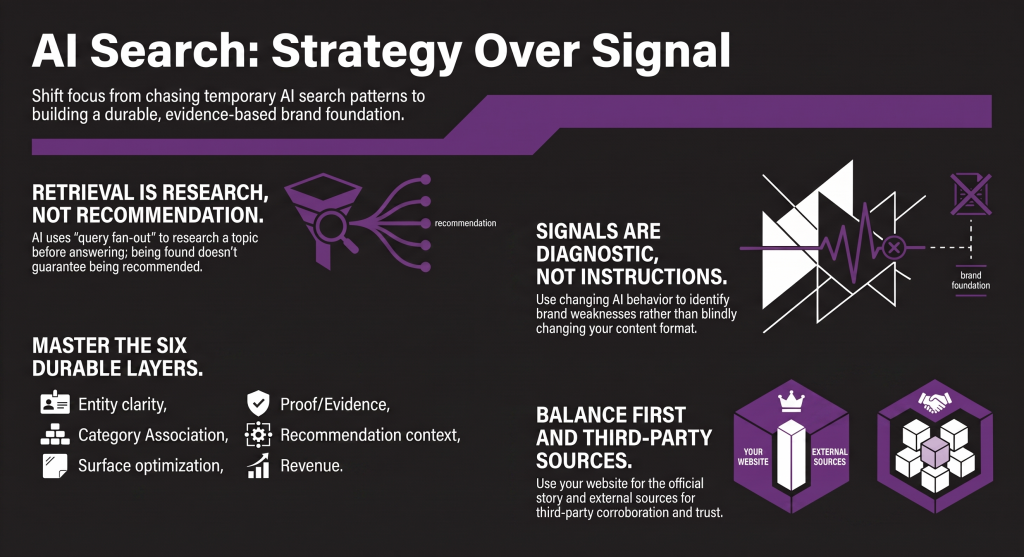
For anyone new to AI search, retrieval is essentially the research stage that happens before an AI system produces its answer.
When you ask an AI search system a question, it does not necessarily look for one page that contains the answer. It may search for multiple pieces of information, sometimes by breaking the original prompt into several related queries. This process is often referred to as query fan-out.
The system then evaluates the sources it finds and uses some combination of them to construct its response.
That distinction matters.
The question you type may be:
What are the best SEO agencies for a B2B company?
The system may effectively research that question through several related searches: which agencies are well known, which specialise in B2B, which have relevant case studies, which are recognised by trusted sources, and which agencies appear to be the official or authoritative entity behind a particular name.
The exact process varies by platform and model. But the important point is that the prompt a user sees is not necessarily the same set of searches the AI system uses to research the answer.
That is one reason the same question can produce different answers across AI systems.
It also explains why changes in retrieval behaviour are interesting - but not necessarily something marketers should optimise for directly.
The problem with turning a signal into a strategy
The real danger is confusing a current signal with a durable rule.
If yesterday's data suggested that AI systems were retrieving more listicles, it does not follow that every brand should start producing more listicles.
If today's data shows more first-party pages appearing in retrieval, it does not mean third-party sources have suddenly become irrelevant.
And if a model starts using site: queries or adding words such as "official" to its searches, that does not necessarily mean brands should restructure their entire content strategy around those specific query patterns.
These observations tell us something about how the system may currently be researching a topic. They do not tell us that a particular content format has become a permanent ranking factor.
This distinction is particularly important because retrieval is not the same as recommendation.
A page can be retrieved without being cited.
It can be cited without being recommended.
And a brand can even be recommended without that recommendation being particularly useful for the business.
Do not let the signal become the strategy.
A strategy built around one visible retrieval preference can easily become reactive. Teams end up producing content to match what the system appeared to do last week, rather than strengthening the underlying information ecosystem that allows the brand to be understood and trusted in the first place.
What changing retrieval behaviour can tell us
That does not make retrieval signals unimportant.
Quite the opposite.
They can provide a useful window into how AI systems are researching a topic and deciding which information deserves consideration.
Recent observations have included more brand-focused fan-out queries, site: searches, "official" modifiers and retrieval from recognised or trusted domains. These patterns have led practitioners to consider whether AI systems are becoming more deliberate about identifying the correct entity, official source and supporting evidence behind an answer.
But these remain observations, not universal laws.
Retrieval behaviour can vary by platform, model, category, prompt and time period. Even fan-out queries can vary depending on the user and context. Lily Ray has cautioned against treating individual fan-out queries as a definitive content roadmap, recommending that marketers instead look for recurring entities, topics and considerations across larger datasets.
That changes how marketers should respond.
Instead of asking:
What format does AI want right now?
ask:
What does this retrieval behaviour tell us about how AI is trying to understand this market, brand or topic?
That is a much more useful question.
A better way to think about AI search
A more durable model is to think about AI visibility as a series of connected layers:
| Layer | What it answers |
|---|---|
| Entity | Who is the brand, product, service or organisation? |
| Association | What category, audience, location or use case is it connected to? |
| Page or surface | Which owned page, profile, review or external source should represent that association? |
| Proof | What evidence supports the claim? |
| Recommendation | Does AI choose or recommend the brand in the right context? |
| Revenue | Does that visibility create qualified demand, enquiries or sales? |
This is a more durable framework than asking which type of page AI happens to prefer this month.
Consider what happens when one of these layers is weak.
- If the entity is unclear, publishing more content may not solve the problem. AI may still struggle to distinguish the brand, product or organisation from similarly named entities.
- If the association is weak, producing more articles may simply create more information without establishing what the brand is actually relevant for.
- If the page or surface is unclear, the information may exist somewhere online but not in a source that clearly represents the brand or answers the relevant question.
- If proof is thin, a page may be retrieved but provide insufficient confidence for the system to rely on it.
- If the recommendation is strong but the destination page does not match the user's intent, the business can still lose the opportunity after visibility has been achieved.
That is the real work of an AI search strategy.
Key diagnostic framework
Use this sequence when a new retrieval pattern appears.
1. Clarify the entity
Check whether AI can identify the correct organisation, product or service.
- Check names and official profiles.
- Separate similarly named entities.
2. Strengthen the association
Confirm the brand is connected to the right category, audience, location or use case.
- Review category language.
- Check whether the right buyer problem is explicit.
3. Match the source
Give each important association an obvious page, profile or external source.
- Improve the relevant owned surface.
- Correct important external profiles.
4. Test the recommendation
Measure whether retrieval leads to citation, recommendation and a useful destination experience.
- Track repeated prompts.
- Do not optimize the retrieval signal alone.
First-party and third-party sources have different jobs
A temporary increase in first-party retrieval does not make third-party sources obsolete.
Your own website and other first-party properties provide the baseline story.
They should make it clear what the brand is, what it offers, who it serves, where it operates, what its products or services include, and which information is official and current.
Third-party sources perform a different function.
They provide corroboration and outside context through reviews, comparisons, industry references, community discussions, commentary and directory-style sources.
Neither type of source needs to do exactly the same job.
Consider a few examples:
- A software company may need its own product documentation and feature pages alongside review platforms and community discussions.
- A local service business may depend on its own service pages alongside reviews, maps and local profiles.
- A professional-services firm may need detailed service information and case studies alongside industry references, independent commentary and information about its practitioners.
The objective is not to make every source on the internet repeat the same message.
Make the same underlying brand reality visible and credible across the places that AI systems and buyers are likely to investigate.
That is much more resilient than trying to predict which individual source type an AI model will favour next.
What to do when retrieval behaviour changes
When you notice a new retrieval pattern, treat it as a diagnostic signal, not an instruction to immediately change your content strategy.
Start by documenting what actually changed:
- Platform and model
- Date of observation
- Category or market
- Prompt sample
- Source mix
- Query or fan-out pattern
- Evidence supporting the observation
- Whether the behaviour repeats across multiple tests
Then work backwards.
Is the brand entity clear?
Can the system easily determine who the organisation, product or service is?
Is the brand connected to the right problem or category?
Does the available information clearly establish what the brand is relevant for and who it serves?
Does each important association have an obvious source?
If the brand claims to specialise in something, is there a clear page, profile or external source that supports that association?
Is there enough proof?
Are important claims supported by evidence, experience, reviews, references, case studies or other credible sources?
Where is the breakdown occurring?
Is the system retrieving the page but not citing it? Is it citing the page but not recommending the brand? Is the brand being recommended for the wrong use case? Or is another source simply providing stronger evidence?
Only after answering those questions should you decide what action to take.
That action might be improving an existing product or service page, strengthening an About page, adding clearer evidence or case studies, correcting information on an external profile, or building stronger third-party corroboration.
The observed retrieval behaviour tells you where to investigate. It does not automatically tell you what content to produce.
That distinction can prevent teams from responding to every new AI-search signal by creating another batch of content in whatever format appears to be working at the time.
Build for the system underneath the signal
AI search will continue to evolve.
Models will change how they expand queries. Retrieval systems will change which sources they investigate. The balance between first-party and third-party information may shift. New search surfaces will emerge, and existing ones will behave differently.
Trying to predict every change is unlikely to be a sustainable strategy.
A better approach is to build the information system underneath your visibility.
- Make the entity clear.
- Strengthen the associations that matter.
- Put important information on the right surfaces.
- Support important claims with credible evidence.
- Build corroboration beyond your own website.
Then measure whether those foundations actually lead to the outcome that matters: being understood, cited and recommended in the right buying contexts.
When model behaviour changes, use the new signal to identify which layer may be weak.
Do not let the signal become the strategy.
Final takeaway
Retrieval patterns are useful because they show how AI systems may be researching a market, brand or topic.
They are not automatically permanent ranking factors, content instructions or universal laws.
Build a strategy around durable foundations: clear entities, strong associations, useful source surfaces, credible proof, third-party corroboration and recommendation fit.
When retrieval behaviour changes, investigate which layer may be weak before deciding what to change.
Diagnose the signal before changing strategy
Use Lumina to monitor how AI systems describe, cite and recommend your brand across prompts and platforms, then investigate the underlying evidence before producing reactive content.
Diagnose AI visibilityReferences
This article was prompted by recent practitioner observations about ChatGPT fan-out queries, site: searches, "official" brand modifiers and changes in retrieval behaviour, alongside reporting that different ChatGPT models can search the web differently.
These observations are useful as directional evidence rather than universal rules. Fan-out behaviour can vary by model, prompt, user context and time period, and individual retrieval patterns should not be treated as definitive evidence of a new ranking factor.
- Lily Ray, Fan-out queries appearing in Google Search Console.
- Lily Ray, Adding "Official" to brand titles.
- Lily Ray, GPT-5.6 retrieval changes.
- Search Engine Journal, Different ChatGPT models search the web differently.