Listen to this article
AI visibility is becoming a serious reporting question for marketing, SEO and growth teams.
The problem is that many teams are trying to answer it with one number.
That number may look simple, but it can hide very different signals:
- More people using AI platforms
- More buyers asking AI tools for answers
- More brand mentions inside AI-generated responses
- More citations to a website
- More AI referral traffic
- More leads, sales or enquiries
These are not the same thing.
A brand can be mentioned without being cited. A website can be cited without the brand being recommended. AI referrals can stay flat while AI still influences branded search or direct visits. Conversions can increase without proving that AI visibility caused the growth.
This is why AI visibility should not be treated as a single score.
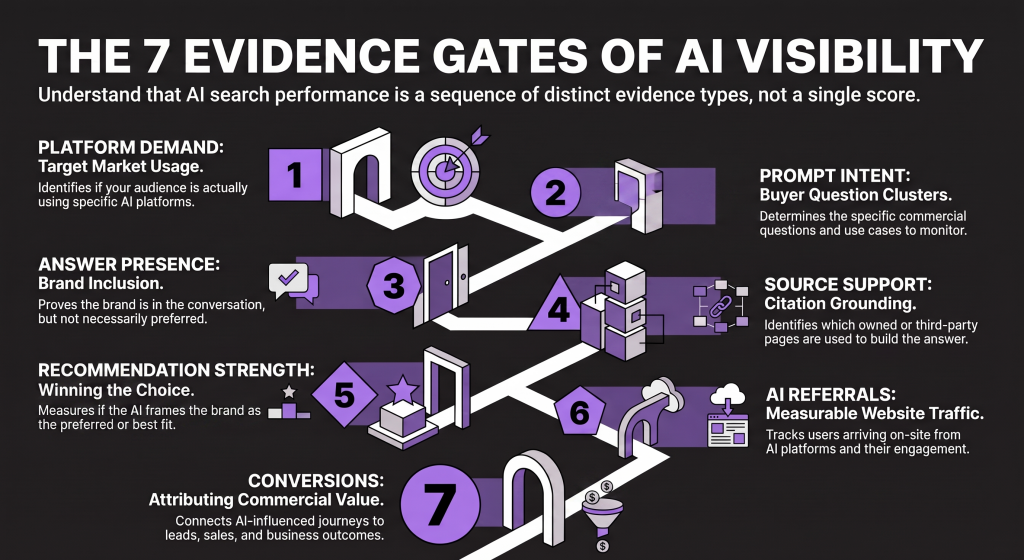
It should be interpreted through separate evidence gates.
What you'll learn
- Why AI visibility is a set of evidence types that need to be read separately.
- How the seven AI Visibility Evidence Gates separate platform demand, prompts, answer presence, citations, recommendations, referrals and conversions.
- What each gate proves, what it cannot prove, and what decision it should support.
- How to use the gates to diagnose AI search performance without overstating the data.
- The goal is not to make reporting more complicated. The goal is to prevent teams from making claims that the data cannot support.
Why a single AI visibility score can mislead teams
A single score compresses too much.
If a visibility score goes up, what actually improved?
- Did the platform become more popular?
- Did the brand appear in more AI answers?
- Did citations increase?
- Did the AI recommend the brand more often?
- Did users click through?
- Did they convert?
Each question points to a different part of AI search performance.
This matters because each layer has a different denominator. Platform usage is measured against the whole platform audience. Prompt demand is measured against the questions buyers ask. Answer presence is measured against tracked responses. Citations are measured against source usage. Recommendations are measured against buyer-choice moments. Referrals are measured against website sessions. Conversions are measured against business outcomes.
When these signals are blended too early, the report may look cleaner, but the interpretation becomes weaker.
Separate the evidence first, then explain what the pattern means.
The AI Visibility Evidence Gates
The AI Visibility Evidence Gates help teams understand AI search performance without collapsing every signal into one score.
| Evidence gate | Main question |
|---|---|
| Platform Demand | Are people in the target market using this AI platform? |
| Prompt And Intent Demand | What are buyers likely asking there? |
| Answer Presence | Does the brand appear in the answer? |
| Citations And Source Support | What sources does AI use to support the answer? |
| Recommendation Strength | Is the brand being chosen or preferred? |
| AI Referrals And Engagement | Is AI sending useful visitors? |
| Conversions | Is AI-related activity creating business value? |
These gates are not a guaranteed funnel. Movement in one gate does not automatically prove movement in the next.
They are evidence boundaries. They help teams understand what each metric can prove, what it cannot prove, and what decision it should support.
1. Platform Demand
Platform Demand measures where people are spending time in the AI ecosystem.
It looks at the overall size, growth and audience makeup of AI platform usage. This can include:
- AI chatbot market share
- Platform usage by country
- App adoption
- Audience overlap
- Desktop versus mobile usage
- Search, social and AI chatbot share as discovery channels
For example, Statcounter's AI Chatbot Market Share shows monthly share across AI chatbot platforms, with country-level filtering. This can help teams see which AI platforms are most used in the target market.
Statcounter also provides a Search vs Social vs AI Chatbot Market Share view, which compares discovery-channel share across search, social and AI chatbots.
Why platform demand matters
Platform Demand helps teams decide where to pay attention.
Not every AI platform matters equally for every audience. A B2B research audience may behave differently from a local consumer audience. A technical buyer may rely on different AI tools from a casual consumer. A country where AI chatbot usage is rising may need a different monitoring plan from a country where search and social still dominate discovery.
This gate helps prioritize the AI environments worth researching.
What platform demand can answer
- Is the target audience likely using this AI platform?
- Which AI platforms are growing in the target market?
- Which platforms should be monitored first?
- Is AI search becoming a meaningful discovery layer in this market?
- Should the team compare AI platform demand against search and social demand?
What platform demand cannot answer
- Did an AI answer mention the brand?
- Was the brand recommended?
- Did an AI platform cite the website?
- Did the user see or click the brand?
- Did the activity generate a lead, sale or enquiry?
Platform Demand in a nutshell: Platform Demand is a macro indicator, not a brand metric. It helps decide where to monitor first.
2. Prompt And Intent Demand
Prompt And Intent Demand measures what buyers are likely asking on each AI platform.
This is the AI-search version of understanding buyer demand. It looks at the questions, prompts, use cases and decision moments that matter to the brand.
This can include informational, comparison, recommendation, local discovery, trust and validation, product or service research prompts, and follow-up questions in a longer decision journey.
Why prompt and intent demand matters
Platform usage is too broad by itself.
Knowing that people use ChatGPT, Gemini, Perplexity or Google AI features does not tell a team what they are asking there. It also does not tell whether those questions matter commercially.
Prompt And Intent Demand helps teams define the right monitoring panel before measuring visibility. Without this gate, AI visibility tracking can easily monitor the wrong questions.
What prompt and intent demand can answer
- What are buyers likely asking AI systems?
- Which prompt clusters match the brand's products, services or audience?
- Which prompts are informational, comparative, commercial or validation-led?
- Which platforms should be tested for which types of questions?
- Which prompt clusters should become the baseline monitoring panel?
What prompt and intent demand cannot answer
- Whether the brand appears in the answer
- Whether the brand is recommended
- Whether the website is cited
- Whether the prompt produced traffic
- Whether the prompt influenced a conversion
Prompt and intent demand in a nutshell: Prompt And Intent Demand turns platform usage into a tracking plan.
3. Answer Presence
Answer Presence measures whether the brand appears inside tracked AI answers.
This is the first brand-level visibility gate. It can include brand mention rate, answer inclusion rate, share of voice, mention position, platform coverage, sentiment and framing, and whether the brand appears in branded or unbranded prompts.
Why answer presence matters
A brand cannot be meaningfully visible in AI search if it does not appear in the answers that matter.
Answer Presence shows whether AI systems place the brand in the conversation for relevant prompts.
But presence alone is not enough. A brand may appear neutrally, weakly, incorrectly or only as a minor option. It may be visible without being persuasive.
What answer presence can answer
- Does the brand appear in AI answers?
- How often does it appear across tracked prompts?
- Which platforms mention the brand more often?
- Does the brand appear for commercial, comparison or validation prompts?
- Is the brand mentioned clearly, vaguely or inaccurately?
What answer presence cannot answer
- Whether the brand was recommended
- Whether the website was cited
- Whether the answer was persuasive
- Whether the user clicked through
- Whether the mention created business value
Answer presence in a nutshell: Answer Presence shows whether the brand enters the AI conversation. It proves presence, not preference.
4. Citations And Source Support
Citations And Source Support measures what sources AI systems use to ground or support the answer.
This can include owned website pages, blog articles, product or service pages, review sites, directories, publications, videos, community platforms, third-party comparison pages, knowledge bases or structured sources.
Why citations and source support matters
AI visibility is shaped by sources.
A brand may be mentioned because the AI system recognizes it, but cited sources may come from somewhere else. A website may be cited for a definition or statistic, but the final recommendation may still favor a competitor.
Citations help teams understand source control. They show whether the brand has useful owned evidence, whether third-party sources support the right story, and whether competitors or external platforms are shaping the answer instead.
What citations and source support can answer
- Is the website being used as source material?
- Which pages are being cited?
- Are the cited pages the right pages?
- Are third-party sources supporting or weakening the brand story?
- Which source types shape the answer most often?
- Is source visibility concentrated in one platform, one publisher or one page type?
What citations and source support cannot answer
- Whether the brand was recommended
- Whether the user saw the citation
- Whether the citation was persuasive
- Whether the citation generated traffic
- Whether the citation created a lead or sale
Citations and source support in a nutshell: Citations prove source usage, not endorsement.
5. Recommendation Strength
Recommendation Strength measures whether the brand is being chosen, preferred, shortlisted or framed as the right fit.
This gate looks at the role the brand plays inside the AI answer. A brand may be recommended as the best option, included in a shortlist, mentioned as an alternative, caveated because of price, location, fit, trust or features, out-ranked by competitors, or cited as a source while another brand gets recommended.
Why recommendation strength matters
Recommendation Strength is where AI visibility starts to connect more closely with buyer decision-making.
Being visible is not the same as being chosen.
A brand can appear in many answers but still lose the recommendation to a competitor. This often points to a proof, positioning, trust, review, comparison or third-party corroboration gap.
What recommendation strength can answer
- Is the brand being recommended for the prompts that matter?
- Is it framed as a strong fit or a weak option?
- Which competitors are recommended instead?
- What reasons does AI give for choosing one brand over another?
- What proof or buyer-fit signals appear to influence the recommendation?
- Does recommendation strength change by platform, prompt type or audience?
What recommendation strength cannot answer
- Whether the user clicked the recommendation
- Whether the recommendation created a lead
- Whether the user trusted the answer
- Whether the recommendation caused a conversion
- Whether the recommendation will remain stable over time
Recommendation strength in a nutshell: Recommendation Strength shows whether the brand is winning the buyer-decision moment inside AI answers.
6. AI Referrals And Engagement
AI Referrals And Engagement measures whether users arrive on the website from AI platforms, and what they do after landing.
This may include referral visits from AI platforms such as ChatGPT, Perplexity, Copilot, Gemini and other assistants when analytics exposes them.
It can also include landing page visits, time on page, scroll depth, return visits, clicks to key pages, form starts, demo, quote or contact actions, and comparison or product-page behaviour.
Why AI referrals and engagement matters
This gate connects AI visibility to measurable website behaviour.
If AI platforms are sending visitors, teams can start asking whether those visitors are useful. Do they read? Compare? Click? Return? Start a lead action?
But AI referrals are still incomplete. Many AI-influenced journeys will not show up as direct AI referrals. A user may see the brand in an AI answer, then search the brand on Google, visit directly, click a LinkedIn post or return later through another channel.
What AI referrals and engagement can answer
- Are AI platforms sending traffic?
- Which AI platforms send the most visitors?
- Which pages receive AI referrals?
- Do AI-referred users engage meaningfully?
- Are AI-referred visitors more or less useful than other traffic sources?
- Which landing pages need better next steps?
What AI referrals and engagement cannot answer
- Whether all AI-influenced users are captured
- Whether AI visibility caused the visit
- Whether no referral traffic means no AI influence
- Whether the user converted later through another channel
- Whether the AI answer itself was accurate or persuasive
AI referrals and engagement in a nutshell: AI Referrals And Engagement show measurable AI-driven visits. They are useful, but they do not capture the full influence of AI search.
7. Conversions
Conversions measure whether AI-related journeys produce business value.
This can include leads, sales, bookings, demo requests, contact form submissions, key events, qualified enquiries, pipeline, revenue or modeled assisted outcomes.
This gate should separate observed outcomes from modeled influence.
Why conversions matters
Conversions are the strongest business outcome gate. They help teams understand whether AI search activity is connected to commercial value. But conversion reporting still needs discipline.
A direct AI referral that converts is strong evidence that an AI platform sent a valuable visitor. But broader business movement is harder to attribute.
If AI citations increased, brand mentions improved and leads rose slightly, AI visibility may have contributed. But it does not automatically prove causation. Paid campaigns, sales activity, branded search, seasonality, website changes and other channels may also be involved.
What conversions can answer
- Did AI-referred users convert?
- How many leads, sales or key events came from AI referrals?
- Are AI-referred visitors higher or lower quality than other channels?
- Did branded search or direct traffic rise alongside AI visibility?
- Is there a plausible assisted path from AI visibility to conversion?
- Are observed outcomes separated from modeled attribution?
What conversions cannot answer
- Whether AI visibility caused all conversion growth
- Whether every AI-influenced buyer was tracked
- Whether a rise in mentions or citations directly created revenue
- Whether one platform deserves full credit for a multi-channel journey
- Whether future conversion patterns will remain stable
Conversions in a nutshell: Conversions show business value, but they do not automatically prove total AI attribution.
Key diagnostic framework
Use these four questions at every evidence gate before making a performance claim.
1. Name the gate
State whether the evidence is demand, prompts, presence, source support, recommendation, referral or conversion data.
- Use the exact evidence type.
- Do not call every signal visibility.
2. Define the proof
Record the denominator and the observations the metric can legitimately support.
- Show what was included.
- State what remains unproven.
3. Check the next gate
Look for supporting evidence without assuming that movement carries forward automatically.
- Compare adjacent evidence.
- Keep correlation separate from causation.
4. Assign the action
Use the evidence to choose the next research or optimization decision.
- Prioritize the weakest meaningful gate.
- Do not optimize the wrong metric.
How to use the Evidence Gates in AI search reporting
The Evidence Gates work best before interpretation. Instead of saying “AI visibility improved,” first ask which gate improved.
| If this moved | The better interpretation |
|---|---|
| Platform Demand | This platform may deserve more monitoring for the target audience. |
| Prompt And Intent Demand | These buyer questions should be added to the tracking panel. |
| Answer Presence | The brand is appearing in more tracked AI answers. |
| Citations And Source Support | The brand's sources, or relevant third-party sources, are being used more often. |
| Recommendation Strength | The brand is being framed more strongly in buyer-choice moments. |
| AI Referrals And Engagement | AI platforms are sending visitors who can now be evaluated for quality. |
| Conversions | AI-related journeys may be contributing to business outcomes, depending on attribution quality. |
This is how teams move from visibility reporting to performance diagnosis.
The better questions are:
- Which evidence gate moved?
- What does that gate prove?
- What does it not prove?
- What should we check next?
- What decision should this support?
What this means for AI search strategy
AI search strategy should not be built around one blended score. It should be built around the weakest meaningful evidence gate.
- If Platform Demand is weak, the platform may not need immediate focus.
- If Prompt And Intent Demand is weak, the team may be tracking the wrong questions.
- If Answer Presence is weak, the brand may not be entering the right conversations.
- If Citations And Source Support are weak, the brand may lack citable owned content or trusted third-party corroboration.
- If Recommendation Strength is weak, the brand may be visible but not convincing.
- If AI Referrals are weak, the issue may be no-click behaviour, citation placement, platform interface or assisted journeys that analytics does not capture directly.
- If Conversions are unclear, the issue may be attribution design rather than visibility itself.
The Evidence Gates help teams assign the right next action.
Final takeaway
AI visibility is not one score because AI search performance is not one event.
It is a set of separate evidence types: platform demand, prompt demand, answer presence, source support, recommendation strength, referrals and conversions.
A useful AI search report should explain what kind of evidence changed, what that evidence can prove, what it cannot prove, and what the team should do next.
That is the purpose of the AI Visibility Evidence Gates.
They help marketing teams understand AI search performance without overstating the meaning of any single metric.
Understand what your AI visibility proves
If your report gives you one score but does not explain what changed, Lumina helps separate prompts, mentions, citations, recommendations and source signals into the right evidence gates.
Map your AI visibilityReferences
- Statcounter, AI Chatbot Market Share.
- Statcounter, Search vs Social vs AI Chatbot Market Share.
- Search Engine Journal, Google's Generative AI Search Console Data Is A Trap For Marketers.
- Search Engine Journal, What It Takes to Get Cited, and Stay Cited in AI Search.
- Marie Haynes Community, Personalization can contaminate AI Overview research.
- Marie Haynes Community, Similarweb publishes 2026 AI-search usage data.
- Lily Ray, LLM visits and AI Overview prevalence.