Listen to this article
SEO is often described as the old way to win search traffic, while AEO is described as the new way to appear in AI answers. That distinction is too simple.
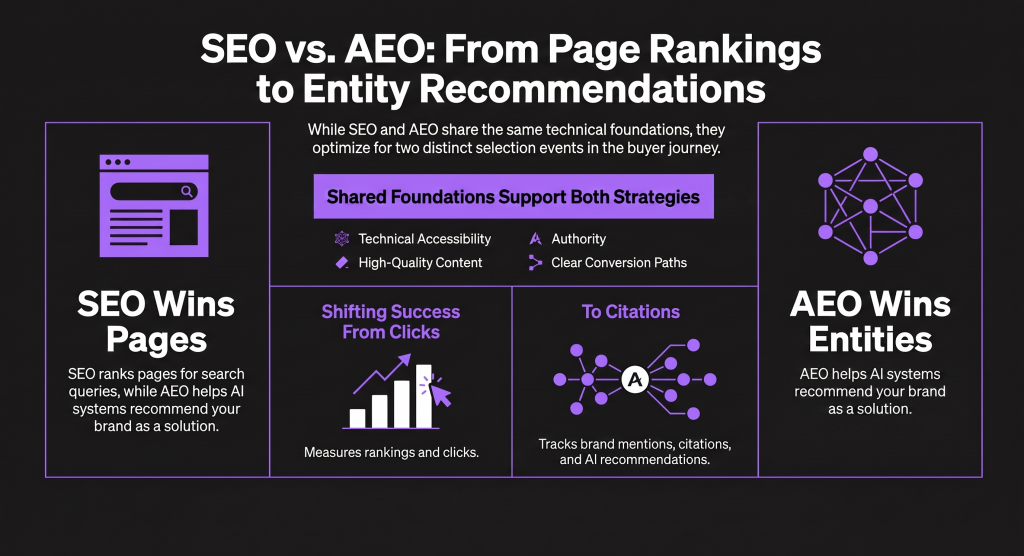
SEO and AEO share many foundations: clear entities, useful content, technical accessibility, strong proof, authority, and a clear path to conversion. The main difference is what each system is trying to select.
SEO helps search engines select and rank the right page for a search query. AEO helps AI systems understand, retrieve, cite, explain, and recommend the right entity when a buyer asks a question.
What you'll learn
- How SEO and AEO share foundations but solve different selection problems.
- Why SEO focuses on page selection while AEO focuses on entity understanding and buyer decisions.
- How to separate measurement baselines and route the next execution sprint.
- Why a weak AI answer does not always require a new article.
The simplest useful distinction
AEO is not simply “SEO for ChatGPT”. It is an additional layer of search strategy that matters when buyers use AI systems to explore options, compare providers, validate claims, and decide what to do next.
- SEO focuses primarily on organic search demand and page selection.
- AEO focuses primarily on entity understanding, associations, sources, recommendations, and buyer decisions.
- Both require useful pages, technical access, proof, authority, and conversion paths.
- SEO measures rankings, impressions, clicks, and organic conversions.
- AEO separates mentions, citations, recommendations, source quality, platform differences, and AI-influenced outcomes.
SEO: the page-selection model
SEO improves a website’s ability to attract and convert organic search demand. A practical model is:
Business Goal → Search Demand → Technical Eligibility → Page Ownership → Content and Conversion Proof → Authority and Distribution → Organic Selection → Revenue
This asks what people are searching for, which topics matter commercially, whether search engines can crawl and understand the relevant pages, which page owns the opportunity, and whether the selected page contributes to business results.
SEO is therefore not only about keywords. It includes technical access, site architecture, page roles, internal linking, content quality, authority, SERP features, user experience, and conversion paths.
AEO: the entity-and-decision model
Answer Engine Optimization makes a brand, product, service, expert, or organization easier for AI systems to understand, retrieve, cite, explain, and recommend. A practical model is:
Entity → Association → Page or Surface → Proof → Recommendation → Revenue
This asks who the entity is, what it should be known for, which categories, locations, audiences, use cases, and buyer needs it should be associated with, what evidence supports those associations, and whether a buyer can move forward.
- Who is the entity?
- What should it be known for?
- Which categories, locations, audiences, use cases, and buyer needs should it be associated with?
- Which page or external surface supports that association?
- What evidence makes the claim credible?
- Will AI mention, cite, or recommend the entity in the right context?
- Does that visibility lead to qualified demand or revenue?
AEO focuses less on one exact query and more on the relationship between an entity and a buyer decision.
For example, a software company may want to be associated with accounting software for small businesses, easy implementation, integrations with specific tools, transparent pricing, and support for non-technical teams. The goal is not only to rank for a phrase such as “best accounting software for small businesses”. The goal is for AI systems to understand when the company is a suitable option, what evidence supports that recommendation, and which source can verify the claim.
Shared foundations, different emphasis
The same content can support both systems, but it has a different job in each. A service page may target commercial search intent for SEO. For AEO, it should also explain what the service is, who it is for, where it is available, how it compares with alternatives, what proof supports the claims, and what the buyer should do next.
Neither strategy should begin with a publishing target or a list of keywords. The first question is: What does the business need to be chosen for?
A business may need more qualified leads, product sales, bookings, applications, local enquiries, or branded demand. The search strategy should then identify which pages, entities, associations, and proof points support that outcome.
Search systems need to understand the relationships between the brand, its products or services, locations, audiences, categories, experts, supporting proof, and conversion paths. They also need to know which page owns each opportunity.
If a website has several pages targeting the same service without a clear primary owner, SEO may suffer from competing or diluted pages. In AEO, the same ambiguity can make it difficult for AI systems to connect the brand with the correct service, location, use case, or buyer need.
Both benefit from direct answers, clear headings, concise definitions, expert input, original experience, case evidence, reviews, comparison criteria, objection handling, descriptive internal links, and visible calls to action.
The difference is emphasis. SEO asks whether the page satisfies search intent and deserves organic visibility. AEO also asks whether an AI system can extract the right answer, connect it to the right entity, and use the evidence to make a reliable recommendation.
Backlinks, reviews, profiles, PR, expert references, social content, and third-party mentions can support both. For SEO, they can contribute to authority and organic selection. For AEO, they provide corroboration, source confidence, sentiment, and additional evidence for recommendations.
| Foundation | SEO job | AEO job |
|---|---|---|
| Clear entity | Helps search engines understand the site and page. | Helps AI identify the correct brand, product, or service. |
| Useful page | Satisfies search intent and supports organic conversion. | Explains the association, evidence, comparison context, and next action. |
| Authority and sources | Supports rankings and branded search trust. | Provides corroboration and confidence for citation and recommendation. |
Measure separate baselines
SEO baseline
- Search demand, query intent, SERP shape, and competitor rankings
- Crawlability, indexability, page speed, canonicalization, and internal linking
- Page ownership, rankings, impressions, clicks, organic selection, and organic conversions
The first execution cycle may become an SEO category sprint: strengthen the main commercial page, improve technical eligibility, add supporting pages, build internal links, improve proof and conversion elements, and earn relevant authority and distribution. The goal is to create a stronger system around one commercially valuable search category before expanding too broadly.
AEO baseline
- The questions being tested
- The platforms and models used
- Whether the brand is mentioned
- Whether the website is cited and which page is cited
- Whether the brand is recommended
- Which competitors appear and which sources AI relies on
- How the brand is described and whether the answer is accurate and commercially useful
AEO work may then be routed to page or content improvements, proof development, source cleanup, third-party distribution, review and profile work, schema or feed improvements, technical retrieval work, or action-path improvements.
The important point is that a weak AI answer does not always require a new article. If the brand is clear but unsupported, the priority may be proof. If the website is strong but AI relies on weak external sources, the priority may be source control or third-party corroboration. If the brand is recommended but buyers cannot easily book, buy, integrate, or enquire, the priority may be action readiness.
A brand can appear in an AI answer without being meaningfully recommended. AI may mention the brand incidentally, cite the website but describe it inaccurately, use the brand as a source without recommending it, recommend the brand only when the user names it first, recommend a competitor for an unbranded buyer question, or give a positive description without providing a useful next action.
This is why AEO should separate:
- Retrieval: Was the entity or source found?
- Citation: Was a source linked or referenced?
- Mention: Was the brand named?
- Recommendation: Was the brand presented as a suitable option?
- Action: Could the buyer move forward?
These are different outcomes. A citation is not the same as a recommendation. A recommendation is not the same as revenue.
Route work to the failing selection event
One of the most useful AEO tests examines the same relationship from both directions:
- What does Brand A offer?
- How does Brand A fit this category?
- Which providers offer this service?
- Which provider should solve this buyer’s problem?
A brand may perform well when directly named but disappear when the prompt begins with the buyer’s need. It is recognized, but not yet recoverable from the category, service, location, or problem it wants to own.
This reveals a directional weakness. SEO can also benefit from this distinction because the same gap may indicate weak category targeting, unclear page ownership, or insufficient authority. However, AEO makes the relationship itself the central unit of analysis.
The two strategies should be connected, but they should not be merged into one vague visibility programme. Start with separate baselines. Use the SEO baseline to identify problems with search demand, technical eligibility, page ownership, rankings, organic selection, and organic conversion. Use the AEO baseline to identify problems with entity understanding, association strength, citation, source quality, recommendation, framing, platform variance, and AI-mediated business influence.
Then choose one primary sprint owner. If the blocker is crawlability, indexability, page ownership, or organic ranking, route the first sprint through SEO. If it is entity understanding, association, citation, source control, recommendation, or AI-mediated influence, route it through AEO. If both matter, define one primary lane and one supporting lane.
Diagnose the selection event before changing strategy
Use Lumina to monitor how AI systems describe, cite, and recommend your brand across prompts and platforms.
Start tracking AI visibilitySEO and AEO are connected, not interchangeable
SEO asks whether search engines can discover, understand, select, rank, and convert the right page for search demand. AEO asks whether AI systems can understand, retrieve, cite, frame, and recommend the right entity for a buyer’s question.
A strong SEO foundation makes content technically accessible, useful, authoritative, and conversion-ready. A strong AEO layer makes the brand’s associations, proof, sources, recommendations, and next actions easier for AI systems to retrieve and interpret.
The durable strategy is not to choose SEO or AEO. Identify which selection event is failing, examine the evidence behind that diagnosis, and route the next action to the model that owns the problem.
Common questions about SEO and AEO
Is AEO separate from SEO?
No. AEO depends on many SEO foundations, including crawlability, useful content, clear page ownership, internal links, authority, and technical accessibility. It adds attention to AI retrieval, citation, recommendation, and action readiness.
Is AEO just adding FAQs?
No. FAQs can help answer real follow-up questions, but AEO can also involve entity clarity, proof, page structure, reviews, third-party sources, profiles, schema, product data, distribution, and conversion paths.
Does ranking well guarantee AI recommendation?
No. A page may rank well but still lack the evidence, comparison context, audience fit, or source corroboration that AI systems need to make a recommendation.
Does a citation prove AI visibility succeeded?
No. Citation is one layer of AI visibility. The citation may be inaccurate, incidental, or attached to the wrong page. Recommendation and business action should be measured separately.
Does an AEO prompt gap always mean we need new content?
No. A prompt gap may point to a stronger existing page, better proof, improved source coverage, technical retrieval work, or a clearer action path. Content should be created only when it has a real buyer decision job.