Listen to this article
Charging AI crawlers sounds like a straightforward commercial decision.
AI companies are using your content, so they should pay for access.
But the ability to charge does not automatically mean the content has pricing power. If an AI system can get the same information somewhere else, placing a toll in front of your content may simply make your source easier to exclude.
That creates a harder question for publishers and brands:
If you restrict AI access, will the AI company pay for your content, or will its products learn to operate without it?
A Search Engine Journal article on charging AI bots explores the new HTTP 402 controls supported by Cloudflare and AWS. These controls give site owners more choice over whether an AI crawler can access, pay for or be blocked from their content.
The technology is useful. But the more important decision sits underneath it.
Before deciding what to charge, we first need to understand whether the content is difficult enough to replace. Crawler monetisation is not just a pricing decision. It is also a decision about where your content, expertise and brand can continue to appear.
What you'll learn
- Why a crawler toll tests scarcity rather than creating content value.
- How to separate discovery content from proprietary content when setting access policies.
- Why training, search and real-time answer retrieval should be controlled separately.
- How to measure crawler revenue alongside lost AI visibility and referrals.
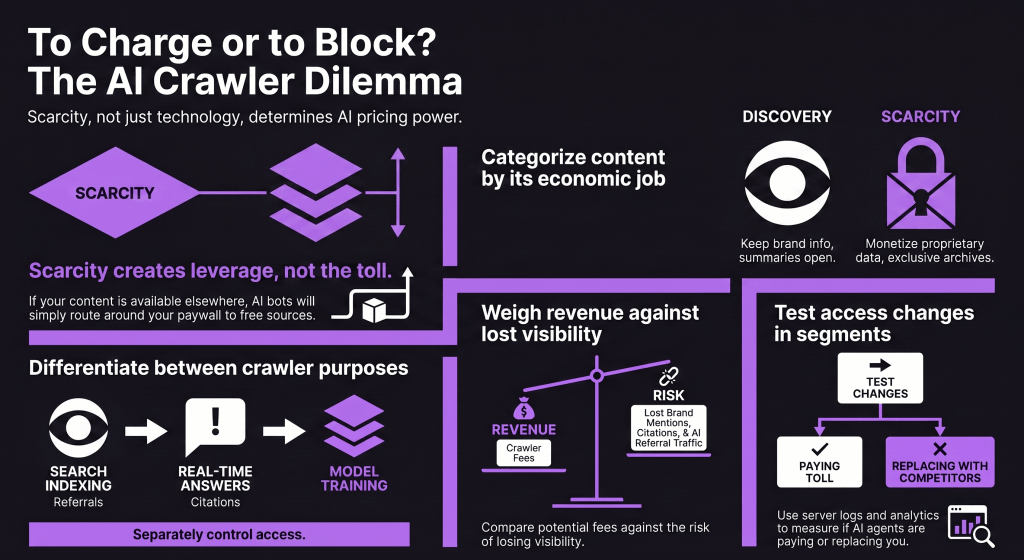
A crawler toll only works when your content is difficult to replace
HTTP 402 gives website owners a payment mechanism. It does not give every page pricing power.
If your article explains a subject already covered by hundreds of accessible sources, an AI system may not need to pay. It can retrieve another publisher, competitor, database or community discussion.
You earn nothing, while your content leaves the available source pool.
The situation changes when you own something the system cannot easily reproduce:
- Proprietary data
- Exclusive reporting
- Specialist archives
- Original research
- Real-time information
- Premium analysis
- High-value tools or APIs
Refusing this content could make the answer less complete, less current or less reliable. The AI provider or agent then has a stronger reason to pay, license the asset or negotiate access.
The toll is not what creates the leverage. The scarcity of the content creates the leverage.
What should remain open, be charged or be blocked?
Decide access according to the economic job and replaceability of the content, not with one rule for the entire domain.
| Content type | Primary job | Starting position |
|---|---|---|
| Brand, product and category information | Help people and AI systems discover, understand and compare the brand | Keep accessible to relevant search and answer crawlers |
| Public explainers and research summaries | Establish authority and introduce deeper expertise | Keep a useful public layer open |
| Proprietary datasets, archives and premium research | Provide scarce information that is difficult to replace | Consider licensing, subscriptions or crawler pricing |
| Tools, feeds and APIs | Help people or agents retrieve data or complete a task | Consider paid structured access |
| Duplicate, abusive or undeclared automated activity | Consumes resources without a useful business return | Rate-limit or block |
For most brands, public content is a distribution asset. Its job is to help the market understand what the business offers and why it should be considered.
Charging an answer-feeding crawler to access that information may work against the purpose for which the content was created.
Publishers have a different problem because their content may be the product. For genuinely scarce research, reporting or archives, paid access can be reasonable.
But publishers still need discovery. The stronger model may be to keep enough content open to establish relevance and demand, then monetize the assets that cannot be replaced.
Why does crawler purpose change the decision?
Training, search and user-directed retrieval create different value for the website owner.
Cloudflare's Content Signals framework distinguishes:
search: building a search index and returning links or excerptsai-input: using content in a real-time AI answerai-train: training or fine-tuning a model
OpenAI also provides separate controls for its crawlers. Its publisher guidance explains that publishers can restrict GPTBot from potential training while allowing OAI-SearchBot if they want their content included in ChatGPT search.
This means protecting content from training does not always require removing it from AI search.
Before changing access, identify:
- Who is crawling
- Why they are crawling
- Which paths they access
- Whether they support search, citations, referrals or user actions
- Whether the content has licensing value
- Whether an alternative source can replace it
Do not treat every automated request as the same business relationship.
Key diagnostic framework
Use this decision sequence before applying a crawler rule.
1. Identify the job
Separate training, search discovery and user-directed retrieval.
- Record the crawler and purpose.
- Identify the paths and content type.
2. Test scarcity
Assess whether another source can replace the content.
- Look for equivalent accessible sources.
- Identify proprietary or time-sensitive value.
How should you test a crawler-access change?
Test one crawler on one content segment before applying a broader rule.
- Establish the baseline. Record crawler requests, server costs, AI referrals, cited pages, brand mentions and competitor presence.
- Choose one segment. Use a clearly defined group such as public explainers, premium research or product documentation.
- Change one condition. Allow, charge or block one identifiable crawler or purpose.
- Compare both sides. Measure payment, infrastructure savings, citations, answer presence, competitors and referrals.
The Search Engine Journal article notes that no public study has yet quantified how much citation visibility a website loses after tolling a specific crawler.
You should therefore treat a decline as a risk to investigate, not a guaranteed outcome. AI answers are volatile, and one missing citation does not prove causation.
Server logs show whether access changed. Analytics show whether referrals changed. AI visibility tracking shows whether answer presence changed.
You need all three.
Measure the revenue you gain and the visibility you may lose
The crawler payment is the easiest part of the result to see. The harder cost may be the answer from which your content or brand disappears.
Your evaluation should include:
- Crawler revenue
- Infrastructure cost
- AI referral traffic
- Brand mentions
- Page citations
- Recommendation presence
- Competitors replacing your brand or content
- Whether the crawler pays or routes around the restriction
Do not assume that every publisher should remain completely open. Also do not assume that introducing a toll makes commodity content valuable.
The practical takeaway
The practical question is:
Which knowledge must remain accessible to create demand, and which assets are scarce enough to monetize?
For brands, the default should usually be open discovery with selective controls.
For publishers, the stronger model may be open discovery combined with paid scarcity through subscriptions, licensing, data products, premium tools, feeds or APIs.
Lumina Visibility helps you monitor how your brand appears across AI platforms, which competitors replace it and which sources influence the answers. Use it with analytics and server logs when testing crawler access, so you can evaluate the revenue you gain without ignoring the visibility you may be giving up.
Measure what crawler controls change
Track AI mentions, citations, competitor presence and answer sources alongside your analytics and server logs before deciding whether a crawler should remain open, paid or blocked.
Monitor AI visibilityReferences
- Slobodan Manic, Charging AI Bots Decides Which Agents Can Still Cite You, Search Engine Journal.
- Cloudflare, Introducing Pay Per Crawl.
- AWS, AWS WAF Adds AI Traffic Monetization Capability.
- Cloudflare, Managed robots.txt and Content Signals.
- OpenAI, Publishers and Developers FAQ.